


7 Benefits of Using an Industrial Fruit Sorting Line
 Aug 06 2026
By skena
Aug 06 2026
By skena
When a fruit processing business handles a few hundred kilograms of fruit, manual sorting may still be manageable. But when daily production reaches several tons or even dozens of tons, sorting quickly becomes one of the most time-consuming stages of the operation.
Workers need to inspect fruit, remove damaged products, separate different sizes and prepare consistent grades for packing or further processing. During peak harvest periods, the problem becomes even more obvious: more fruit arrives at the factory, but labor capacity does not increase at the same speed.
This is where an industrial fruit sorting line can make a significant difference.
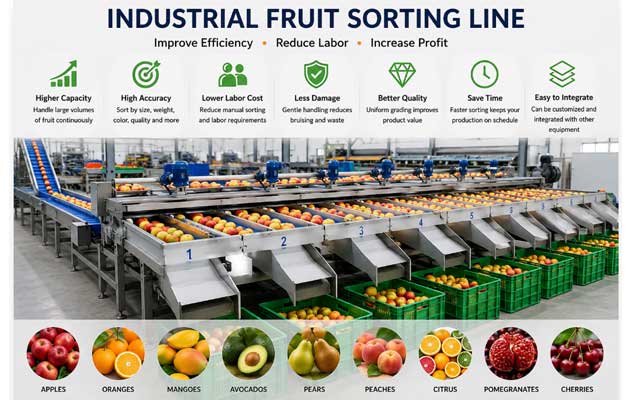
Rather than simply replacing manual workers, an automatic sorting system changes how fruit moves through the entire processing plant. Here are seven practical improvements that processors can expect.
1. More Fruit Can Move Through the Factory
The first benefit is straightforward: higher throughput.
A manual sorting station is limited by the number of workers available and how quickly they can inspect each fruit. An automated system can continuously receive, transport and classify fruit, helping the factory maintain a stable processing speed.
This becomes particularly important during short harvest windows.
For an apple packing plant, mango processor or citrus exporter, processing fruit quickly can be just as important as processing a large volume. Delays at the sorting stage can affect washing, packing, storage and transportation schedules further down the production line.
In other words, increasing sorting capacity can improve the efficiency of the whole plant—not just the sorting section.
2. Every Batch Can Follow the Same Grading Standard
Imagine two workers sorting the same batch of mangoes.
One worker may consider a fruit “large,” while another may put the same fruit into the medium category. After several hours of repetitive work, concentration can also decrease.
Automation makes the grading standard more repeatable.
Depending on the configuration, a fruit sorting machine can classify products according to weight, size, color, appearance or other specified parameters. Once the grading criteria are established, the system can continue applying the same standard throughout production.
This is especially useful when supplying customers who require consistent product specifications.
3. Less Dependence on Seasonal Labor
Harvest seasons can create a difficult labor problem.
A factory may need significantly more workers for several weeks or months, even though the same number of workers may not be necessary during the rest of the year. Recruiting, training and managing seasonal workers can therefore become a major operating challenge.
Automation reduces the amount of repetitive manual sorting required.
Workers are still important, but their roles can shift toward:
- Production supervision
- Quality inspection
- Machine operation
- Packaging
- Maintenance
- Material handling
The result is a processing plant that is less dependent on continuously expanding the sorting workforce.
4. Better Use of Different Fruit Grades
Sorting is not only about separating “good” and “bad” fruit.
A properly designed grading system can divide fruit into several commercial categories.
For example:
Grade A → Retail / Export
Grade B → Domestic Market
Grade C → Juice / Puree / Drying
Reject → Waste or Other Treatment
This approach can increase the value obtained from each batch of raw material.
Instead of treating every fruit that does not meet premium standards as waste, processors can redirect suitable lower-grade fruit to another processing application.
For businesses handling expensive seasonal fruit, this can be an important advantage.
5. Faster Sorting Can Mean Faster Packing
Sorting rarely exists as an independent process.
In many fruit processing plants, the sequence looks something like:
Receiving → Washing → Drying → Sorting → Grading → Packing → Storage
If sorting is slow, the packing section may have to wait. If packing is faster than sorting, fruit can accumulate between the two stages.
An industrial fruit sorting line helps balance these processes by providing a more continuous flow of material.
This is particularly valuable for exporters and large fruit packhouses where production schedules are closely connected to shipping and delivery times.
6. Automation Creates Room for Future Expansion
A common mistake is to think only about today's production capacity when selecting processing equipment.
A business may currently process 3 tons per hour but plan to increase production after entering a new market. If the existing sorting system cannot handle additional capacity, upgrading later can become expensive and complicated.
A properly planned fruit sorting solution can instead become part of a scalable processing system.
For example, a plant may initially install an automatic sorting system and later connect it with:
- Additional grading outlets
- Automatic packing equipment
- Fruit waxing equipment
- Electronic weighing systems
- Robotic handling equipment
- Additional washing and drying equipment
The sorting line therefore becomes one part of a larger automation strategy.
7. The Biggest Benefit: More Control Over the Business
The most important benefit may not be speed or labor savings.
It is control.
With manual sorting, production managers have limited control over how consistently fruit is graded throughout a long working day. With an automated system, sorting parameters can be defined, monitored and adjusted according to production requirements.
That gives the business greater control over:
Capacity — how much fruit can be processed.
Quality — how products are classified.
Labor — how many people are required for sorting.
Consistency — whether different batches follow the same grading standard.
Product value — how different grades are directed to different markets.
For a growing fruit processing business, these factors can have a much larger impact than simply increasing the speed of one machine.
What Does an Industrial Fruit Sorting Line Look Like in a Real Factory?
Consider a mango processing plant receiving several tons of mangoes during the harvest season.
Instead of workers manually inspecting every fruit, the production process can be organized as:
Mango Receiving
↓
Washing & Cleaning
↓
Water Removal / Drying
↓
Automatic Sorting & Grading
↓
Different Grade Outlets
↓
Packing or Further Processing
Premium mangoes can be prepared for the fresh market, while other grades can be directed toward mango pulp, puree, drying or other processing applications.
The same concept can be adapted for apples, oranges, avocados, pears, citrus fruits, persimmons and other commercial fruits.
When Does It Make Sense to Upgrade from Manual Sorting?
Not every fruit business needs a fully automated sorting line from day one.
However, automation becomes increasingly attractive when you encounter several of these situations:
- Production volume is increasing rapidly.
- Seasonal labor is difficult to recruit.
- Customers require consistent fruit grades.
- Manual sorting is slowing down packing.
- Too much fruit is being damaged during handling.
- The factory wants to process multiple grades.
- The business is preparing for export markets.
- Production needs to continue for longer shifts.
If several of these problems are already occurring, the question may no longer be “Should we automate?”, but rather “Which level of automation is suitable for our production?”
Choosing the Right Sorting Solution
There is no single fruit sorting machine that is suitable for every processing plant.
The right configuration depends on the fruit itself and the production target.
Before selecting equipment, consider:
Fruit: What type of fruit will be processed?
Capacity: How many tons per hour are required?
Grading: Do you need weight, size, color or multiple grading criteria?
Handling: How delicate is the fruit?
Final market: Is the fruit for local sales, supermarkets, export or further processing?
Expansion: Will production increase in the next few years?
These factors determine the type, capacity and configuration of the final sorting line.
Final Takeaway
An industrial fruit sorting line is more than an automatic replacement for manual inspection. It can become the control point between raw fruit receiving and the final commercial product.
For growing processors, the advantages are practical: higher throughput, more consistent grading, lower dependence on seasonal labor, better utilization of different fruit grades and a smoother connection between sorting and packing.
And when the sorting system is designed as part of a complete processing line, it can also provide a foundation for future factory automation.
If you are planning a fruit sorting project, provide your fruit type, processing capacity and grading requirements. A suitable sorting and grading solution can then be designed around your actual production needs.